The AI Spec Sheet Now Starts at the Wall
The signal from SC26
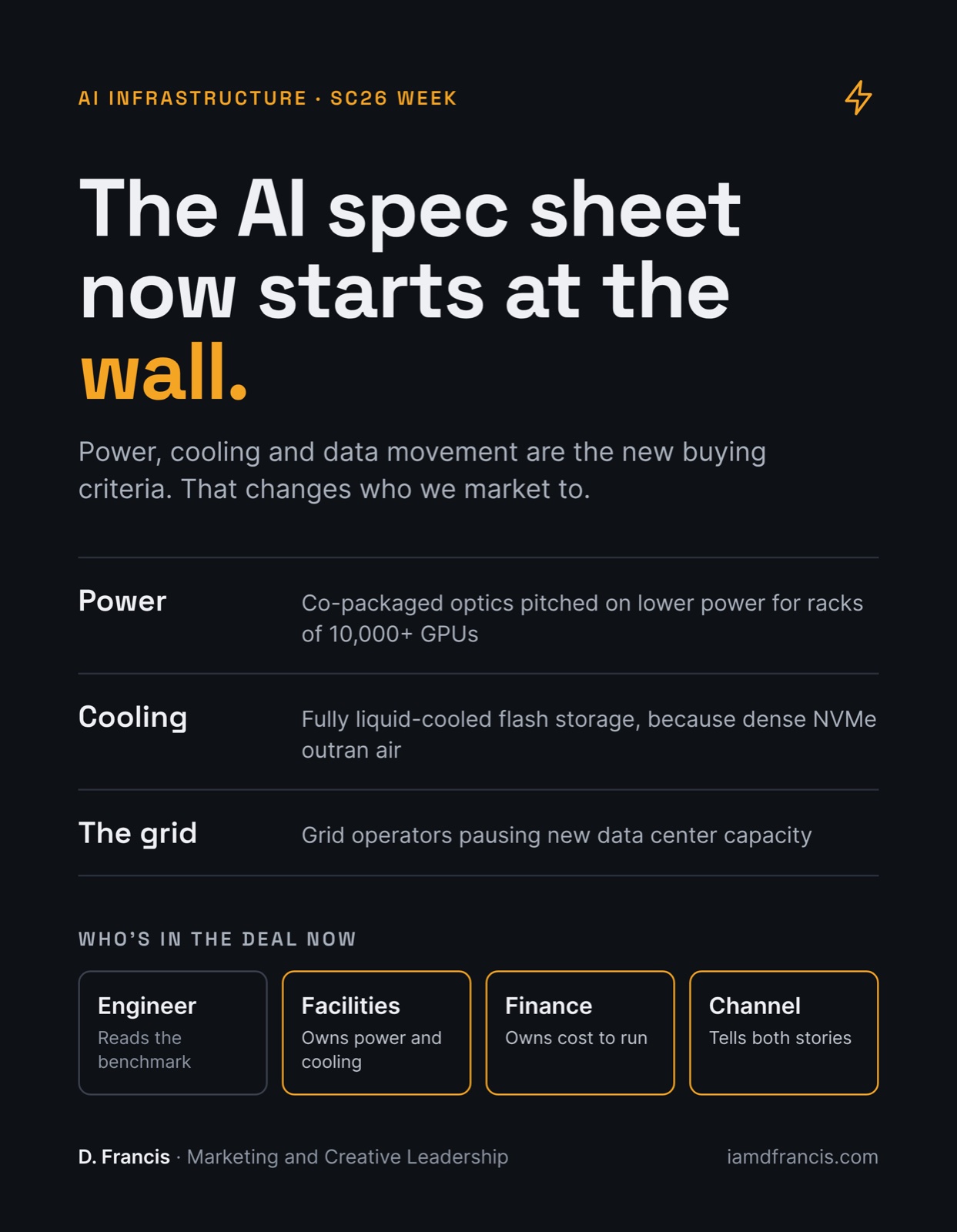
The biggest supercomputing show of the year opened in Chicago this week, and the most telling announcements were about the building, not the chip. NVIDIA highlighted co-packaged optics switches linking racks of more than 10,000 GPUs, pitched on lower power and better resiliency. Dell led its storage news with a 100% direct liquid-cooled NVMe node, because dense flash enclosures now run too hot for air.
Outside the show, the same week brought a grid operator in Norway pausing new data center capacity, operators hunting for used turbines, and record US power demand forecasts. The constraint on AI has moved from silicon supply to power, cooling and data movement.
Why this changes the marketing job
When the bottleneck moves, the buying committee moves with it. A GPU deal used to be won with the engineer who reads the benchmark. Now it also runs through three people who rarely read a spec sheet:
- The facilities lead, who owns the power envelope, cooling design and rack footprint.
- The finance lead, who owns payback and asks what the hardware costs to run, not just to buy.
- The channel partner, who has to carry both stories into the account without a solutions architect on every call.
If the marketing still speaks only to the engineer, the deal stalls in rooms we never entered.
How I'm adjusting the playbook
- Lead with efficiency, not peak specs. Frame performance as outcomes per watt, per rack and per dollar to operate.
- Build enablement for the facilities conversation. Partners need plain-language answers on power draw, thermal design and footprint.
- Sell the whole data path. Storage and networking now decide how fast an AI system turns data into results.
- Equip the channel first. Prioritize enablement content and portal resources that let a reseller answer the power and cooling question on the first call.
- Measure the right things. Track which assets partners use in facilities and finance conversations.
The takeaway
The next AI infrastructure cycle will not be won only by the fastest silicon. It will be won by brands that make buyers confident the system fits the power, cooling and budget they already have. That is a marketing problem as much as an engineering one.
Sources: At SC26, NVIDIA Unveils the Latest Advancements in Scientific Computing, NVIDIA Blog. Dell AI Factory news blast headlined by liquid-cooled storage, Blocks and Files, November 16, 2026. Weekly Data Centre News, November 13, 2026. SC26, November 15 to 20, 2026, Chicago.
Views are my own and do not represent any employer.
Article navigation
← Back to Insights Next: Leading Through a Leadership Transition →
Next