Inference Is Coming Home
Last week's election may reshape AI infrastructure more than any product launch this quarter.
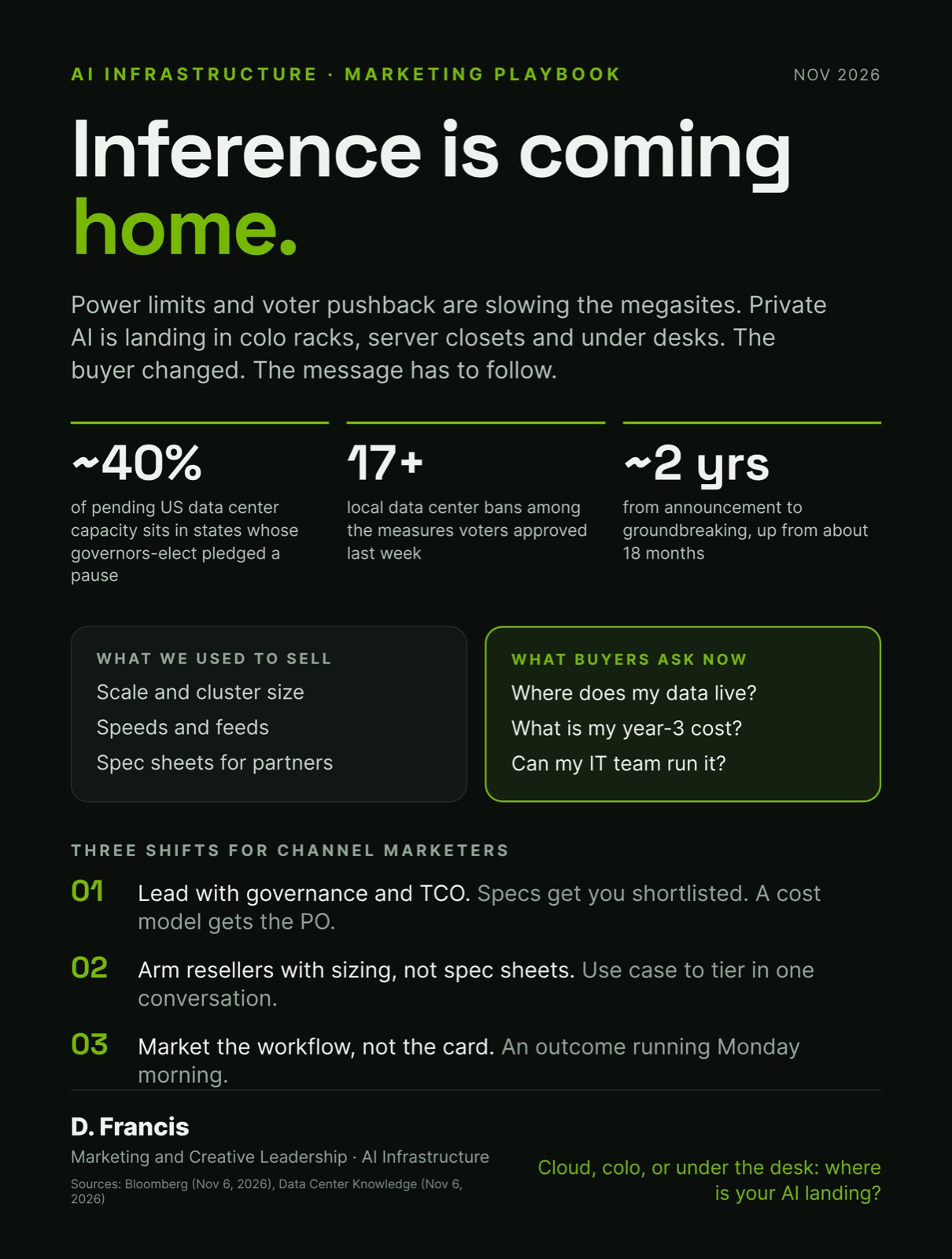
About 40% of pending US data center capacity now sits in states whose incoming governors campaigned on pausing construction. Voters approved dozens of local data center measures, at least 17 of them outright bans. Even where projects move forward, the wait from announcement to groundbreaking has stretched to roughly two years, and grid access is the biggest bottleneck.
The megasites are not going away. But the next wave of inference is landing closer to the data: private clouds, colo racks, server closets and under the desk. Enterprises want predictable token costs, control over their IP, and models that run where their data already lives.
For those of us marketing AI infrastructure through the channel, that changes the buyer and the brief.
- Lead with governance and TCO. Specs get you shortlisted. A three-year cost model gets the PO.
- Arm resellers with sizing, not spec sheets. A partner should go from use case to the right tier in one conversation.
- Market the workflow, not the card. Show the outcome running Monday morning, on hardware the customer's IT team can support.
This is where channel marketing earns its seat. The partner who can answer where data lives and what it costs in year three wins the deal before the competitor finishes the spec comparison.
What's behind the read
| Signal | What it means | Source |
|---|---|---|
| Pending capacity is concentrated in states considering pauses | Megasite timelines get less predictable | Bloomberg via Insurance Journal, November 6 |
| Projects can wait roughly two years after announcement | On-prem and colo become faster paths | Data Center Knowledge, November 6 |
| Token cost and IP exposure are pulling workloads on premises | Marketing shifts to data control and TCO | SiliconANGLE, August 31 |
| Inference is moving on premises and to the edge | A tiered desk, closet and rack story beats a flagship-only pitch | NAND Research, March 20 |
One honest caveat: analysts disagree on how much compute is truly constrained, and delays are more likely than cancellations. This is a market read, not a doom take.
Sources: Bloomberg via Insurance Journal, Data Center Knowledge, SiliconANGLE and NAND Research.
Views are my own and do not represent any employer.
Article navigation
← Previous: Marketing AI Infrastructure to Government Back to Insights →